There and back again.
A trip over the NSW border to Tocumwal by steam
In May 2026, Steamrail announced the Tocumwal Steam Spectacular, a day trip to the border town operated by three steam locos, plus a sleeping car option.
Given it was the first steam trip to visit the town in 20 years, there was plenty of interest in the tour amongst our group of regular travellers, and across the wider enthusiast community.
Over the past couple of years, Steamrail have developed a great operating model for running day trains to places at the extremities of the network that don’t have loco turning facilities, which requires locos to travel long distances tender first.
The issue with having to travel tender first is that train speed is reduced to 50 kmh, which makes the day trains difficult, or worst case, unviable.
To overcome this, the day train has been been supported by a loco positioning move happening the day / evening prior. This involves taking a loco, coal and water, and crew cars to the last (or only) station on the line with a turntable funnel first, turning the engine, then proceeding at the reduced speed to the destination. The V Line crew then go to rest, and are able to get a decent break before they drive the train back to Melbourne.
This allows a loco to be facing the right way for the day return trip, and ensures the crew are rested and within their hours.
Similarly, once the day train arrives, the trains shunted, and the loco is serviced, the off coming crew are able to go to rest, and, after getting the appropriate break, running the train back to the depot with the turntable tender first at reduced speed, before turning the loco and heading back to Melbourne at the normal heritage train speed, where permitted.
The Bairnsdale trips had both worked really well, but the extra move of selling a sleeping car option to travel to Tocumwal was an extra cherry on the cake.
After bouncing a few messages around, there was two of us interested in the night train, but, due to other commitments, neither of us could travel Friday night.
The idea of travelling on the day train to Toc, then returning overnight seemed like an interesting, although rather expensive one, and although it wasn’t offered as an option on the website, after some enquiries with Steamrail, it was agreed that it could be done.
Unfortunately, when I went to book the sleeper train, it had sold out!
I quickly secured a place on the waiting list, so it was a case of wait and see.
We booked the day train with some other friends, so at least we had that covered.
A week out, we got the good news that a compartment had come available, so the money was quickly paid this time, and we were in!
I was pretty excited, the last time I’d travelled behind R 761 overnight in the wooden bodied sleeping cars was waaayyy back in 1994!
The plan for the weekend was to have R 711 (the blue oil burner) take the sleeping car and service train up Friday, leaving Newport at 12:15, going via Sunshine, and the Albion loop to Broadmeadows.
However, in true railway style, it was made known to Steamrail the day before the trip that ARTC (who ‘maintain’ the Albion loop) have a ban on R class locomotives traversing that section.
A change of plans, and new circular, saw Vline’s heritage diesel A 66 pull the train into the ‘Arrivals yard’ at North Melbourne, and the train proceeding via South Kensington and the passenger lines to Broadmeadows instead.
I could hear it departing the Steamrail depot, but didn’t set eyes on it, as I was unfortunately at work, sitting in a fairly bland Teams meeting. From photos I’ve seen, it looked spectacular as it made its way north over the great divide.
Saturday morning was our turn, Paul, Sean and I meeting at Newport Station to catch the 06:47 to Spencer St. / Southern Cross, being joined at Footscray by Clayton who would be travelling back with me on the night train.
Walking over the Bourke St. concourse, we could see smoke rising from R 761 at the front of the train, while A2 986 was still under the roof of the station, having led the train in from Newport.
A few photos from up top, before we headed off in various directions, a couple to platform two to get a photo, coffee was also in demand, and platform three where the train would be departing from.
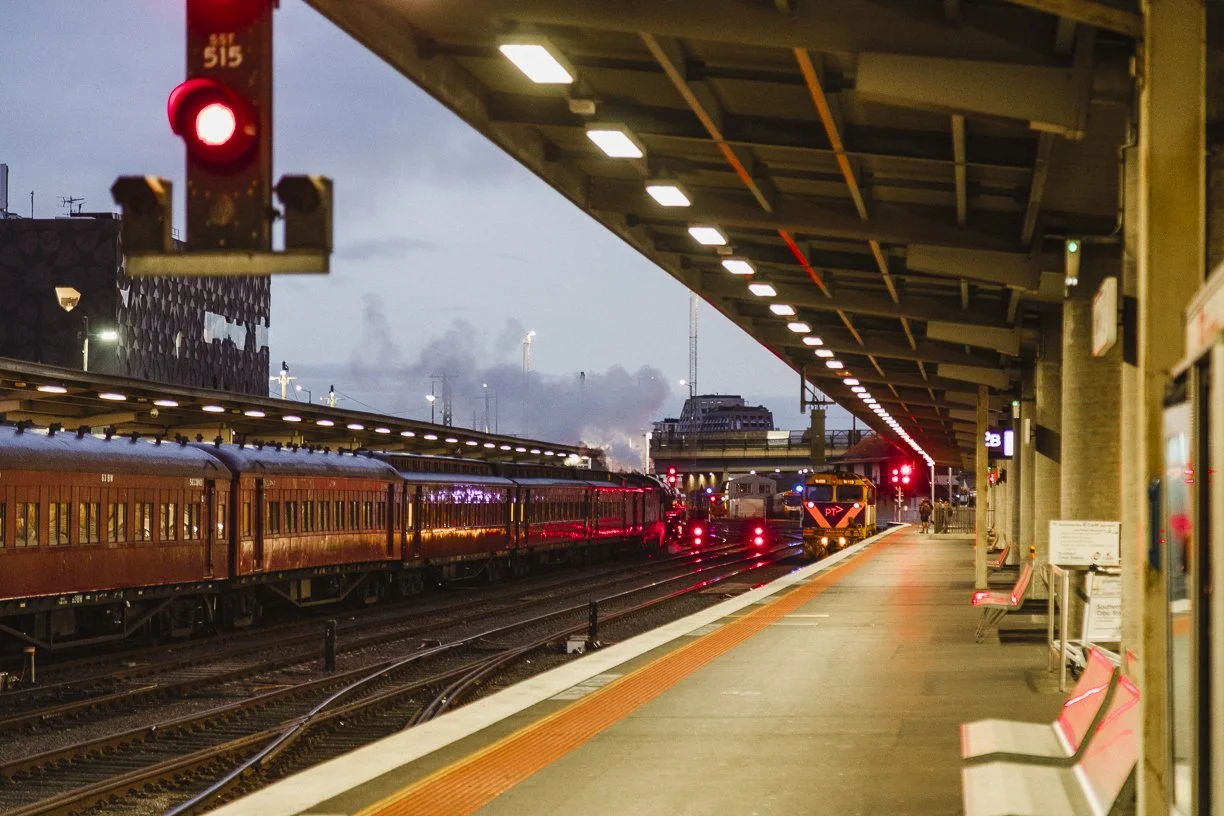
N 458 comes down platform 2 at Southern Cross to drop on the cars to form the Swan Hill passenger service, now Vline’s only loco hauled train.
N 458 was arriving to drop on to the cars for the morning service to Swan Hill, while on platform one, the XPT was chugging away, with power car XP 2011 ‘Milo’ at the Sydney end.
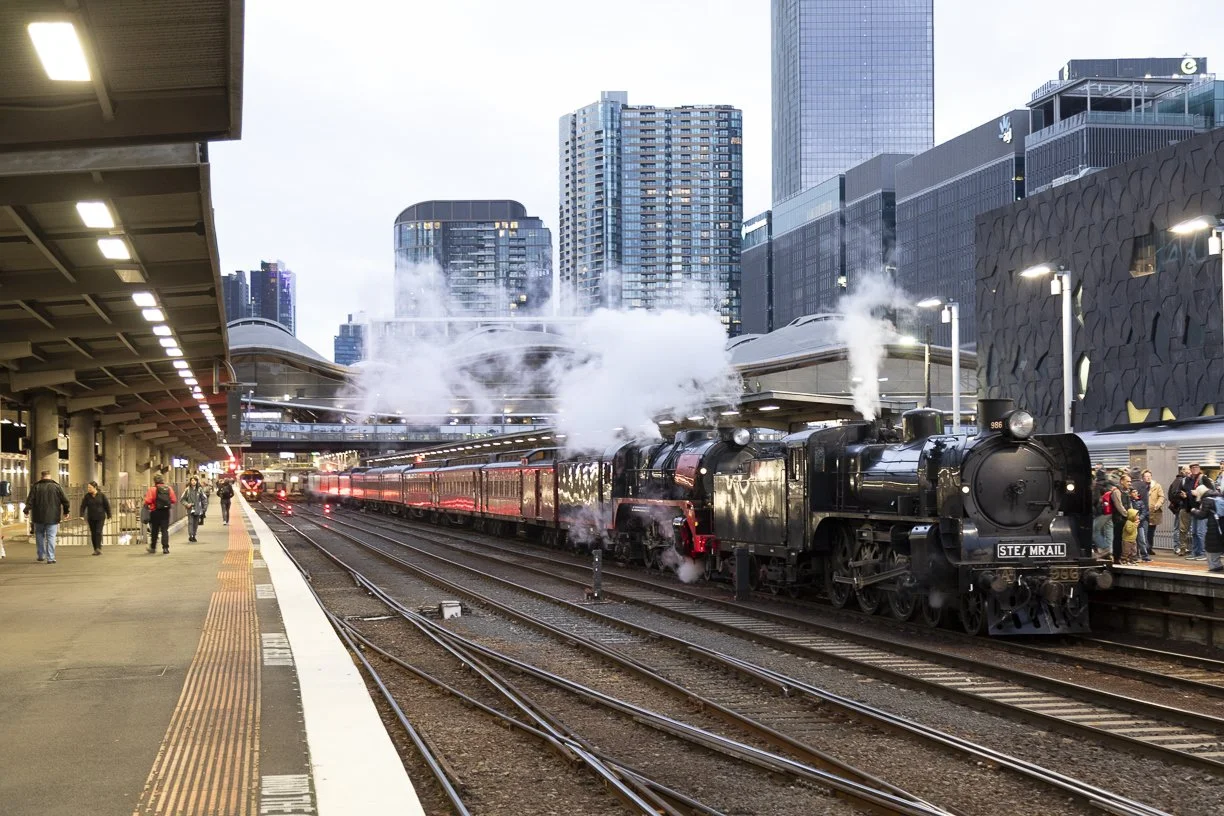
The sky is getting lighter as A2 986 has joined R 761 at the head of the train.
As always, there’s other friends to catch up with, before joining the train, and settling in.
We were booked in car 12, the first car behind the loco, which was 1 BCE. Built in 1910 as a combined mail sorting and second class coach, it, and four other classmates we rebuilt in the 1930s retaining the five compartments, with a van section and guard’s section replacing the mail sorting area.
The compartments are smaller than some of the other E cars, so with six of us ( Rob and Max being our other two companions), things were snug, but comfortable.
Travelling with eight as they were designed for would have been outright squeezy!
Due out at 07:45, we departed about 10 minutes late, after a couple of Vlocity services came and went, heading out through North Melbourne, and swinging through Moonee Ponds Creek Junction towards Kensington.
The line climbs from here through to just past Essendon, before dipping down to Pascoe Vale, then climbing almost continuously to Heathcote Junction, 53 km from where we started.
We had windows open fro the climb from Pascoe Vale, but due to the chilly air, closed them again until we passed Wallan, and then opened then again until we reached the top of the divide at Heathcote Junction.
There had been quite a number of photographers at the suburban stations, but the crowd on the top of the cutting at the summit was next level, I’d estimate 20 to 30 people crammed in together to get their shot.
With the chilly air, and the A2 leading the R on an elegant looking train, there’s been some great shots on social media.
There had been large mobs of kangaroos in paddocks from when we reached the suburban fringe, and this continued through to Seymour, where after crossing the swollen Goulburn River we arrived about 5 minutes down.
Being in the first car was helpful as I was able to get a couple of shots of the locos before the hordes descended, mindful to keep out of the way of the servicing crew who were running a fire hose across the platform to give the R a drink.
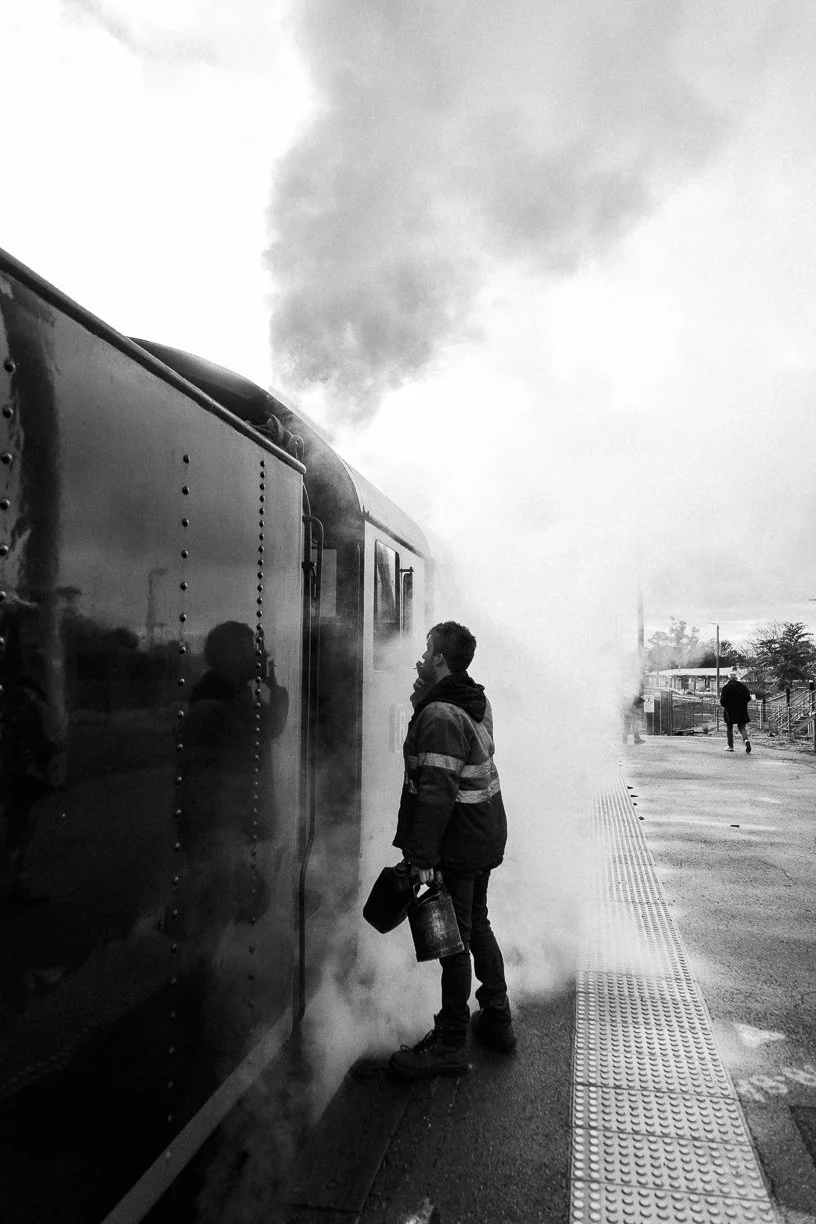
Under driver’s instructions, and ready to oil around at Seymour.
The A2 was cut off here, and headed to the loco to turn and stable ready for the run home in the afternoon. I understand it may have been used to help shunt the Seymour group’s Deniliquin train that was due out after our departure, with cars out of order, and some even requiring turning to make the train up!
The Sydney bound XPT arrived and departed while we were at Seymour, so I managed to get a shot of that while we were there.
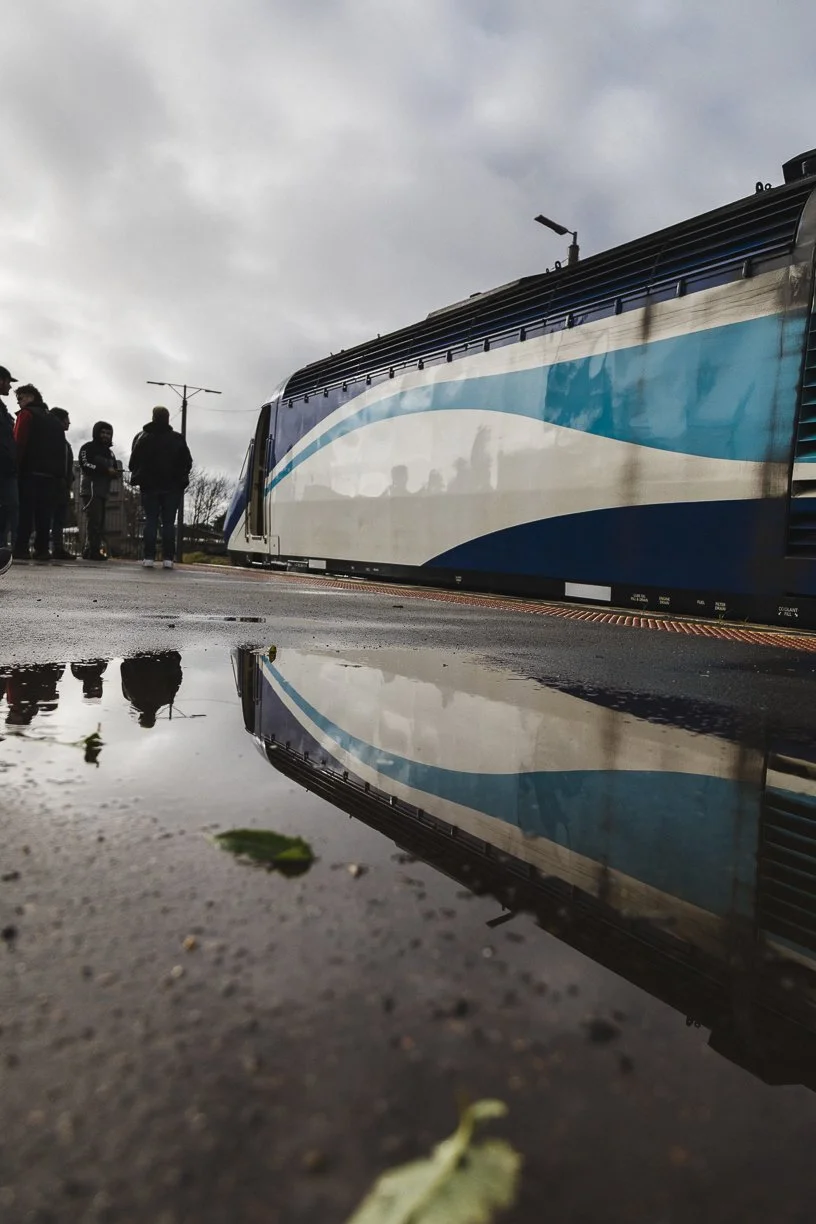
The XPT gets some attention from enthusiasts as it sits on the standard gauge platform at Seymour.
Prior to our Seymour departure, I made my way to car 4, Moorabool to pick up some refreshments, and was still in the line when we departed six minutes late at 10:12.
The Buffet crew of Chris, Floyd and Graeme were flat out, so it was past Mangalore, the former junction of the Albury and Sheparton lines by the time I made it back to our seats.
Nagambie, Murchison East, and Toolamba, the junction of the currently closed line to Echuca went past, before we reached the heart of fruit canning country at Maroopna, then recrossed the Goulburn into Sheparton.
The Sheparton Preserving Company has had a long history in the area, with the rich farmlands of the valley being home to acres of fruit and veg, dairying also being a large employer in the region, but globalisation is seeing a large reduction in these industries.
The train was supposed to have a five minute stop at Sheparton, but we were signalled through, and made a non stop run through town.
On the northern outskirts, a relatively new three road train stabling and refuelling facility has been constructed for servicing the Vlocity fleet that now run a greatly increased passenger service to Melbourne, with five services each way serving the city, on a 2 1/2 hour trip isn’t much longer than Melbourne to Bendigo.
Just past this facility, another closed line could be seen swinging off to the right, formerly serving Dookie and Katamatite, grain producing areas.
Continuing north, the road parallels the line, it was interesting to sit back and observe some of the dubious behaviour of people chasing the train, both the hard core enthusiasts, or the average iPhone holder who may not have seen a steam hauled train before.
Numurkah was the next, and with another closed and lifted branchline, this one to the west, and Nathalia and Picola, then another former junction, this time to Cobram.
Cobram had a passenger train service until 1993, one of a few lines to loose its service in the Vline era.
We were now travelling over jointed track, rather than welded, even sitting in the middle of our carriage, the six wheel bogies were making a fairly sharp heavy metal beat, rather than a gentle clickety clack, even at the relatively low speed we were traveling.
Passing from open farm country into river red gum and swamp gums, with billabongs and creek beds full of water was an indication we weren’t too far from our destination.
The long approach bridge over the floodplain with its steel mesh deck was a giveaway we were close to the river, and the lift bridge that once carried both road and rail traffic between the two states.
Plenty of whistling from the loco - I’m not sure if it was to announce our arrival, or encourage the large number of spectators gathered on both sides of the river to step back a bit.
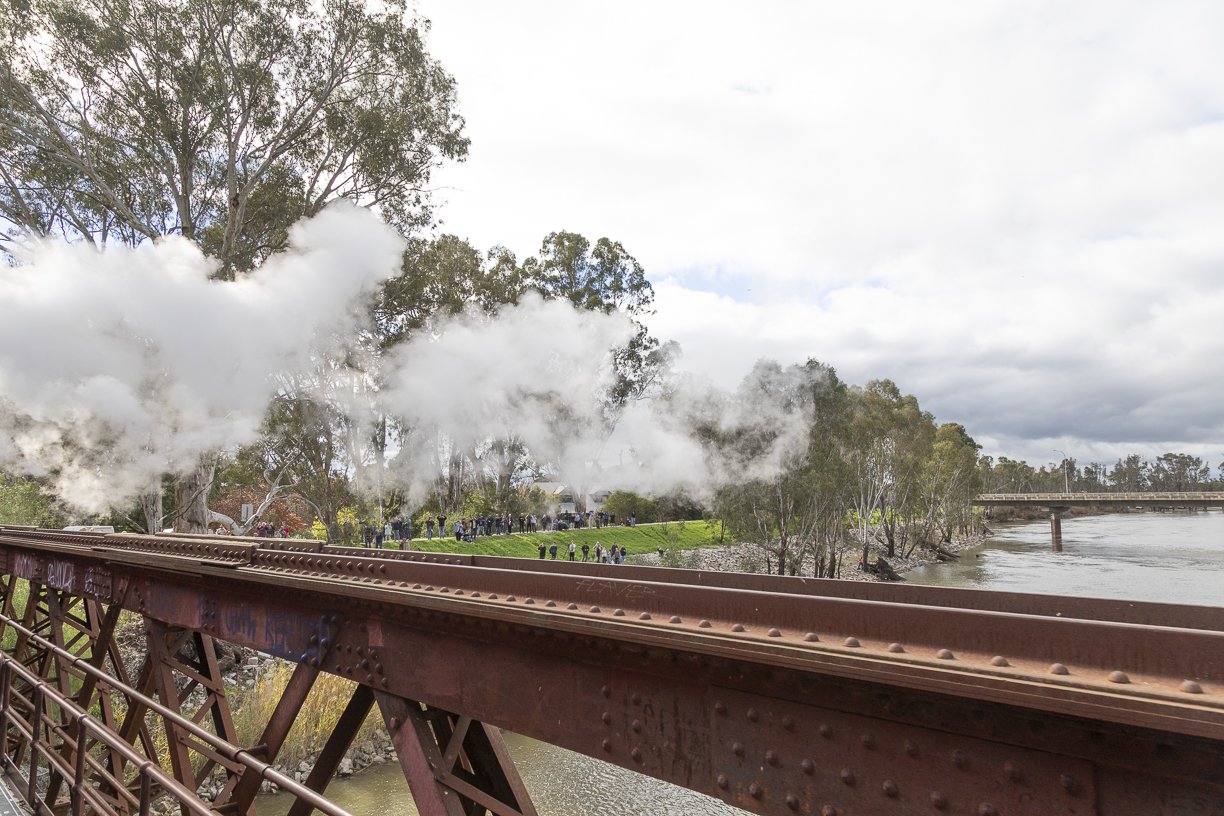
Crossing the Murray River with a crowd of onlookers. The bridge has gone from being road only, to road and rail, and now rail only as the Newell Highway passes over the bridge to the right.
As the platform came into view, there was a very large crowd both on the platform, and on the roadside waiting for the arrival.
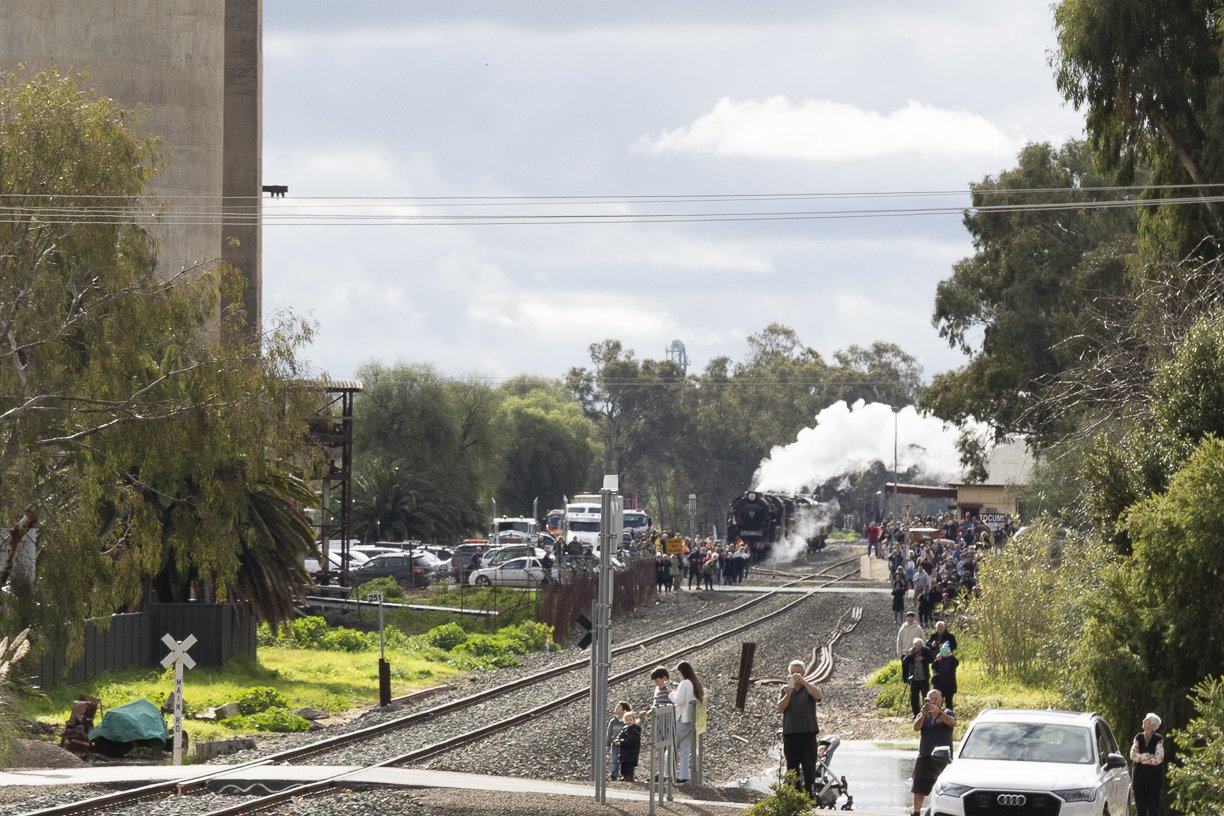
A big crowd lines both sides of the tracks as our train comes into Tocumwal, with R 711 and the sleeping car / service train sits in No.2 road. The population of Toc is around 2000 people, most of them seemed to be out for a look at the train.
I’m curious to know how the crowd compared to opening day in 1908, when the Victorian Railways extended the line across the river to the broad gauge terminus, to be met six years later by the NSWGR line built south from Narrandera.
Tocumwal was one of three VR and NSWGR break of gauge stations, Albury and Oaklands (north of Yarrawonga) being the other two.
Albury is fairly obvious, with rails crossing the border in 1883, and still forms the main line between Sydney and Melbourne.
Oaklands was reached by the NSWGR in 1912, so is fairly contemporary with the Tocumwal extension, with the VR being late to the party, arriving in 1938.
Tocumwal and Oaklands were both built as light branch lines, however carried considerable tonnage of military and other goods during the second world war, taking pressure off the transhipment resources at Albury.
For Tocumwal at least, it branched off the end of the double track line north of Seymour at Mangalore, and the NSW end went to Naranderra, which joined the Main South at Junee, also at the end of the double track line from Sydney, the line beyond to Albury was, and still is single track.
Tocumwal also had a large airforce training centre on the edge of town, so would have been extremely busy during that time.
Of the two branches, the NSW closed theirs to Oaklands in the early 80s, and Tocumwal in 1988, but both the former VR lines are still open from the south, however these days Oaklands is part of the standard gauge network.
Our companions headed up the street, while Clayton and I waited at the station to dump our overnight bags, rather than lugging them around with us.
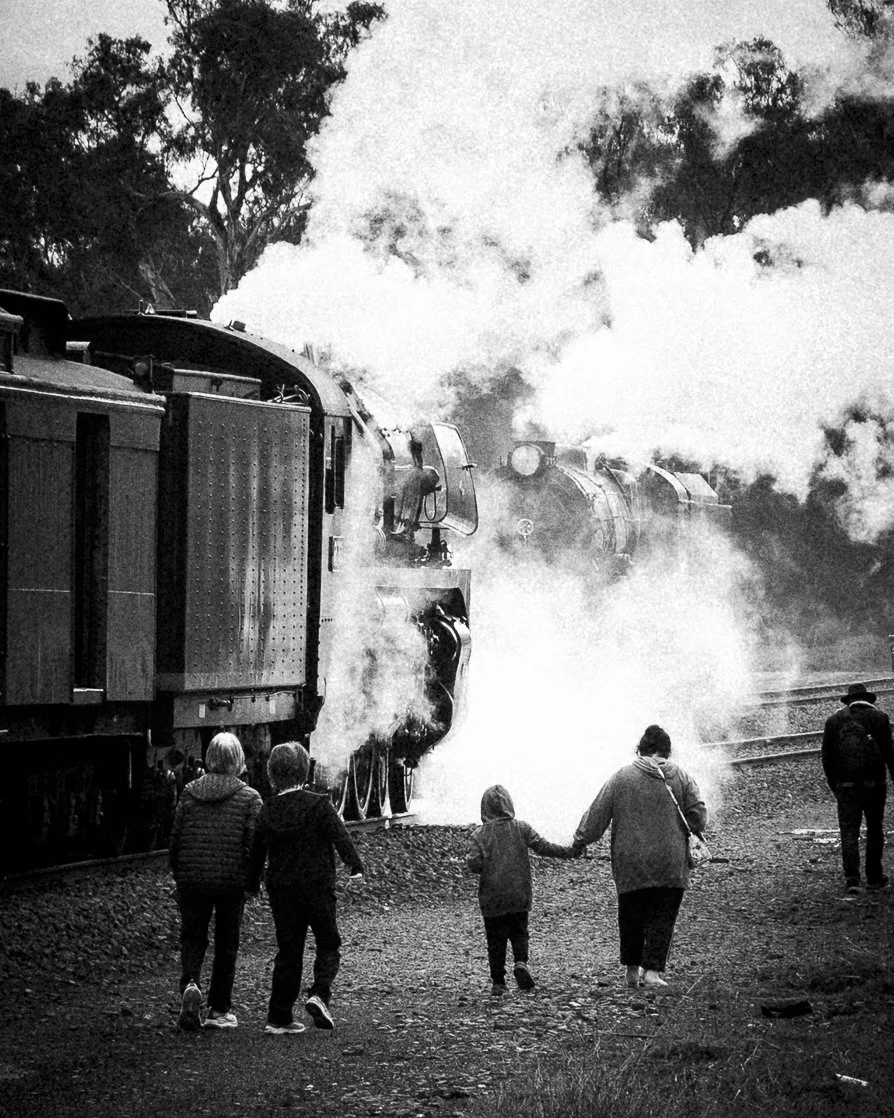
The two R’s face off as some locals wander up for possibly their first look at a steam loco.
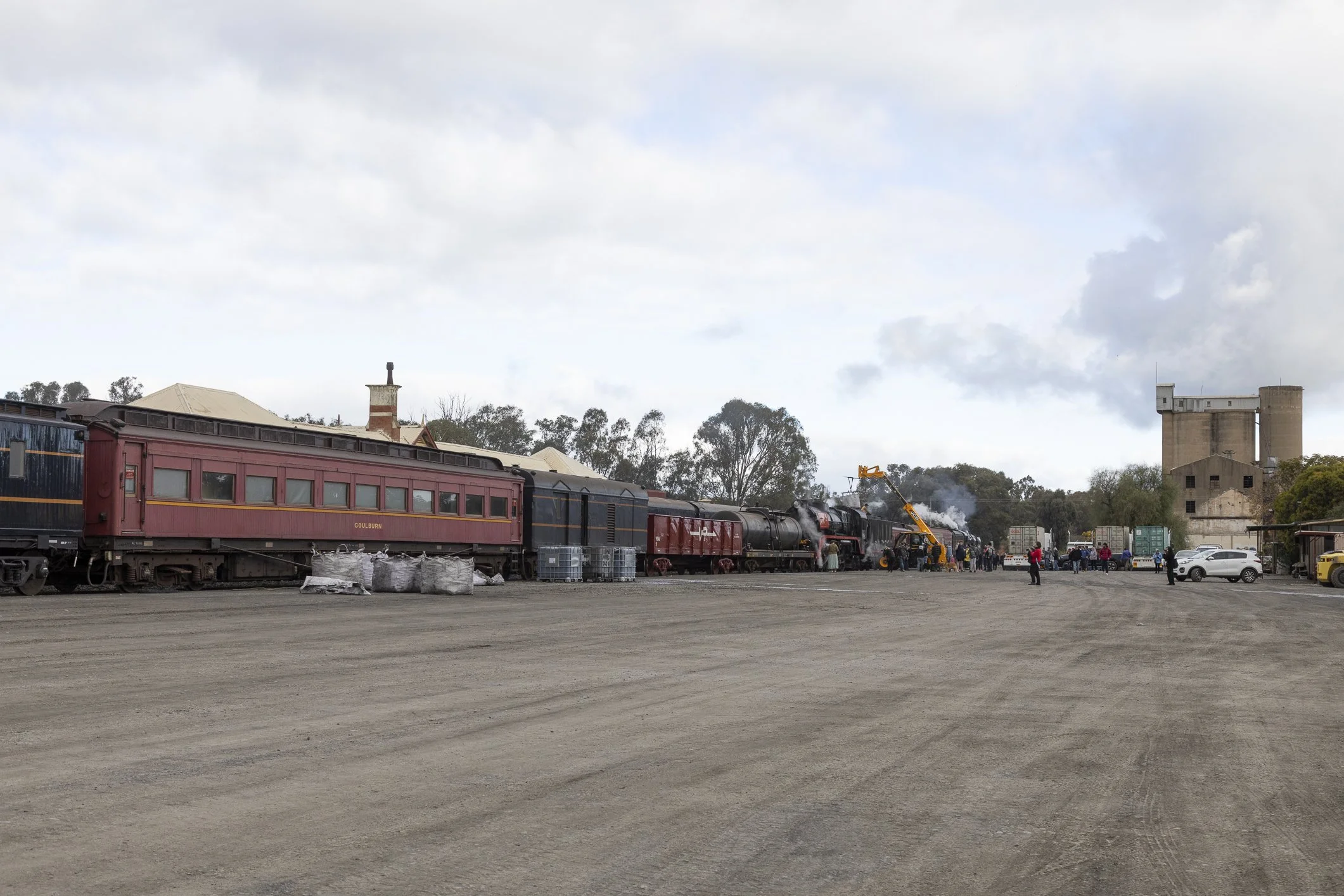
With locos swapped, R 761 gets its tender filled. Goulburn is used as the Steamrail crew car, featuring a lounge area, kitchen and sleeping berths. The blue car to the left is Carey, a unique vehicle I talk about a bit later.
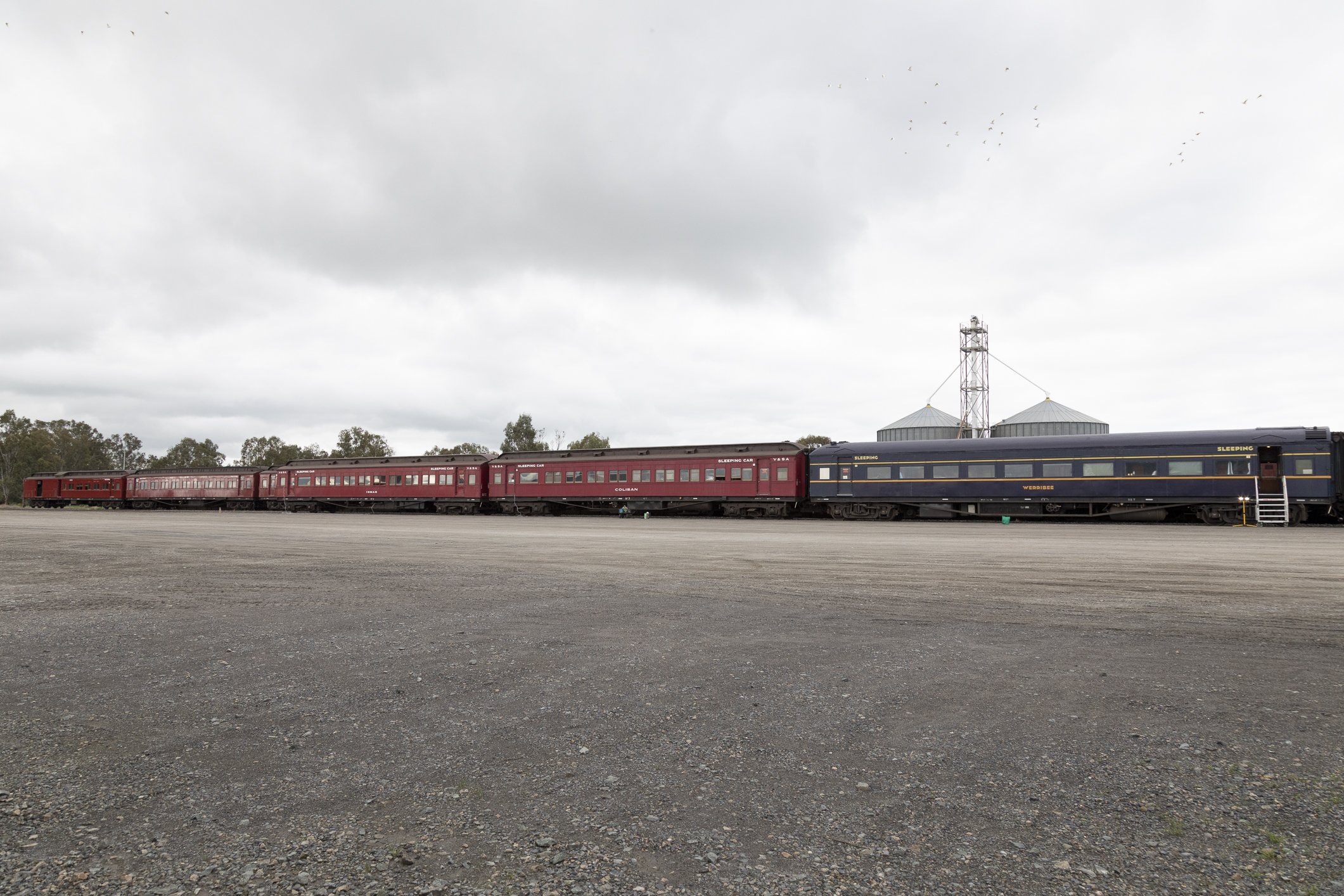
The nearest three cars, Inman, Coliban and Werribee are the sleeping cars of our train home. Werribee is one of two wooden bodied airconditioned sleeping cars in the Steamrail fleet, once used on The Vinelander service to Mildura.
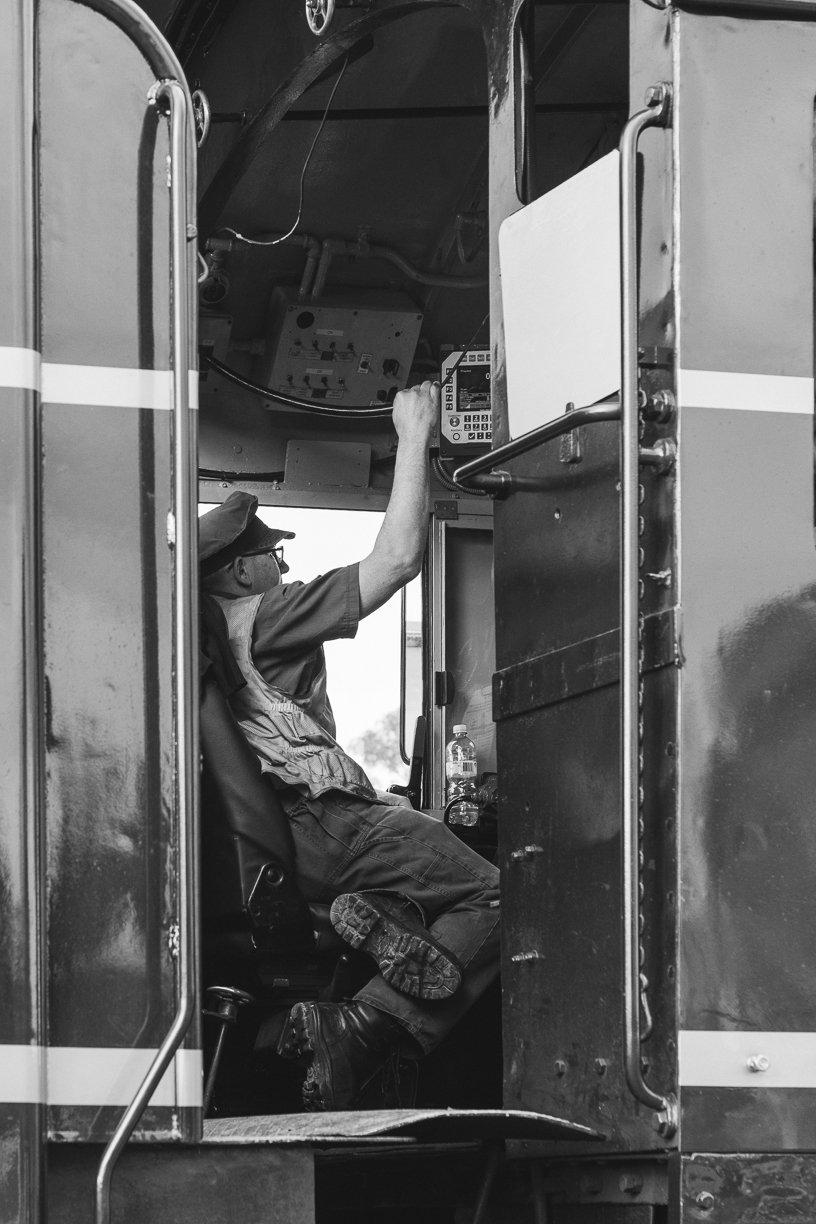
Driver Darren about to give the whistle of R 711 some steam while positioning the train in the platform.
Once we’d taken a couple of photos, and the two trains had finished shunting moves, we were able to put our bags in our new home, compartment 11 and 12 in Coliban, a 1923 built non air-conditioned sleeping car, then headed back outside to get a few more photos before heading up the street to get some lunch and refreshments.
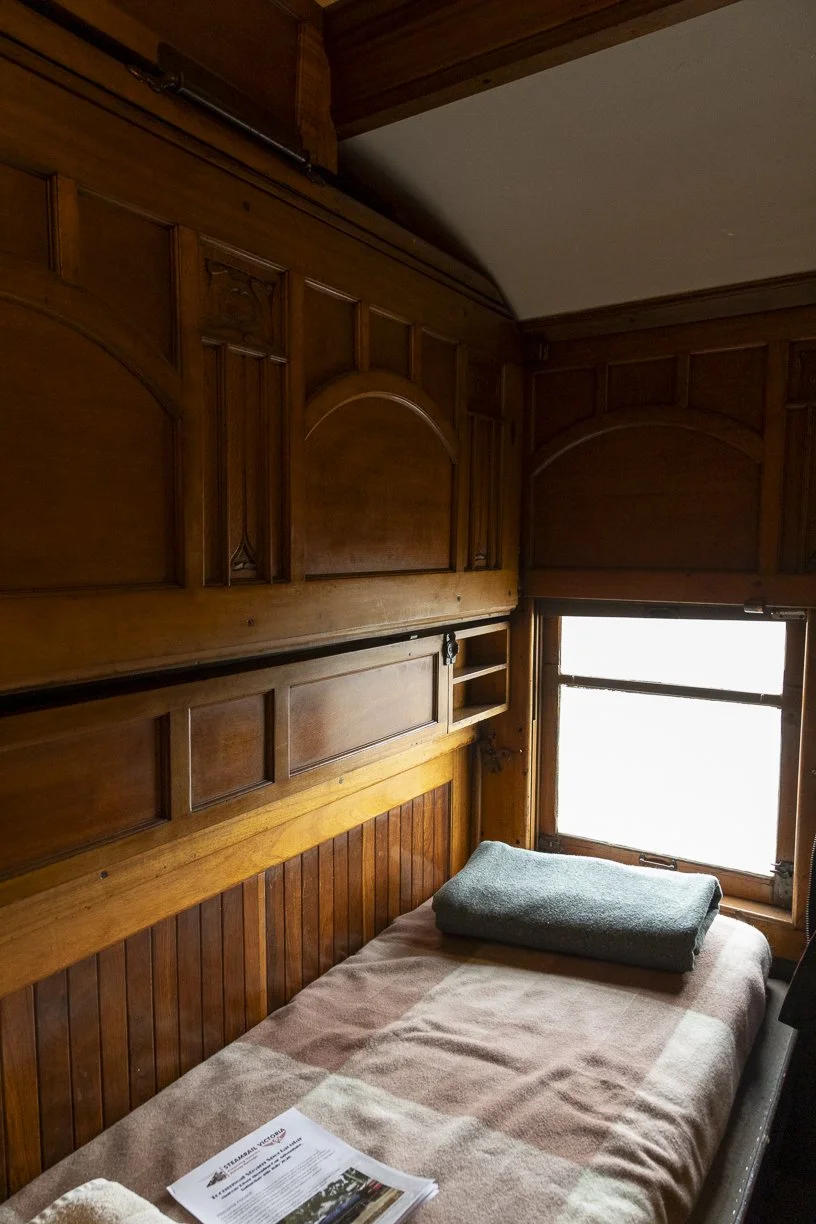
The classy interior of our sleeping compartment in Coliban.
The bakery had done a great trade, so it was slim pickings but tasty, and did the job.
We caught up with the rest of our group at Tattersalls hotel where they had only recently arrived, where we had a beer to wash down lunch before the group split up, some going to the local brewery, others going to another pub across the road.
We joined the brewery group, and had time for one very nice beer before heading back towards the station, saying our goodbyes on the way, with Clayton and I heading towards the road bridge over the Murray to get a photo of the train departing.
Time passed very quickly, I had hoped to visit the Tocumwal Railway Heritage Museum in the railway station, but that just hadn’t happened, but I’m thinking there’s a road trip coming up to Toc to visit the museum, and some of the other attractions of this pretty little town.
As departure time drew closer, the crowd had grown on the riverbank, but there was only five of us on the road bridge, which was ok, as we were standing in the bike lane.
There were several drones buzzing around overhead, but far enough up and away not to be annoying.
We could hear the train leaving the station - it was only a short distance away, slipping a few times as it got close due to the short steep pinch to get up to the bridge, before appearing through the trees.
We fortunately had a gap in passing B Doubles, so Clayton got some uninterrupted video, and I got some photos.
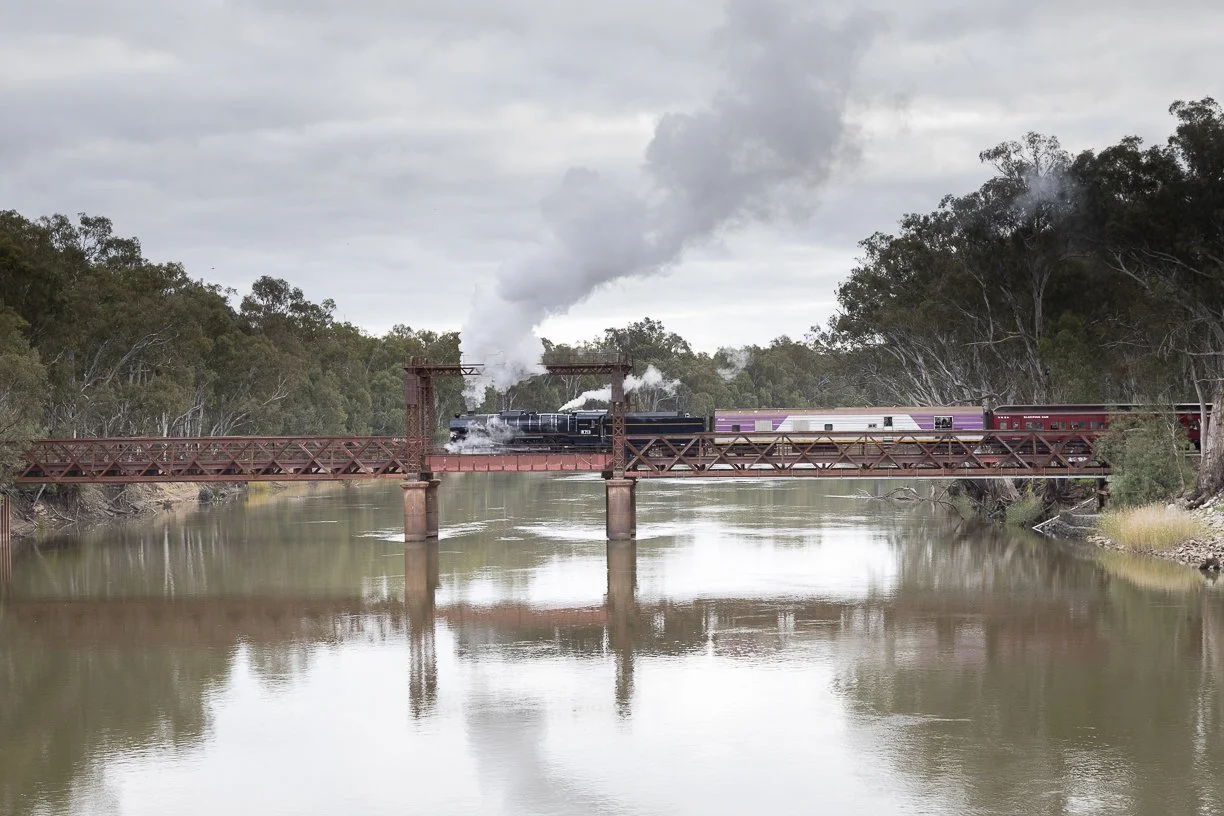
R 711 traverses the lifting span of the Murray River bridge. There’s several bridges of similar design still in place between NSW and Victoria, a relic from the days of a busy river trade when paddle steamers were a major form of transport.
It felt odd watching the train depart, and being left there with no car to chase it, like a bit of an adventure.
To go with the odd, we made our way to the Terminus Hotel, just near the station and settled in to watch the football, certainly not a normal thing for me, but I was happy to sit in the pub and soak up the atmosphere, and watch Collingwood get up over Goldcoast, much to Clayton’s delight.
As we’d only had the one beer at the brewery, we headed back to sample a couple more, but they had unfortunately closed by the time we got there. As it was close, we went to Tattersalls for dinner while watching Carlton get the points over Richmond.
Aside from the footy, I found it quite interesting the music being played in the back bar was very much of an era - the same stuff that was getting played when I was in my late teens - Cold Chisel, The Angels, Bryan Adams, The Eagles, still popular, and very relatable, and still country pub staples.
We decided to go to The Palms, the pub across the road for one more to give it a tick, it was a very different vibe, younger crowd, and more modern music, so we didn’t hang around too long before heading back to the train so I could get some night time photos, and get some sleep before we left.
There was no-one around, so we were able to wander freely and get plenty of photos, always interesting in the dark, and far easier than when we arrived!
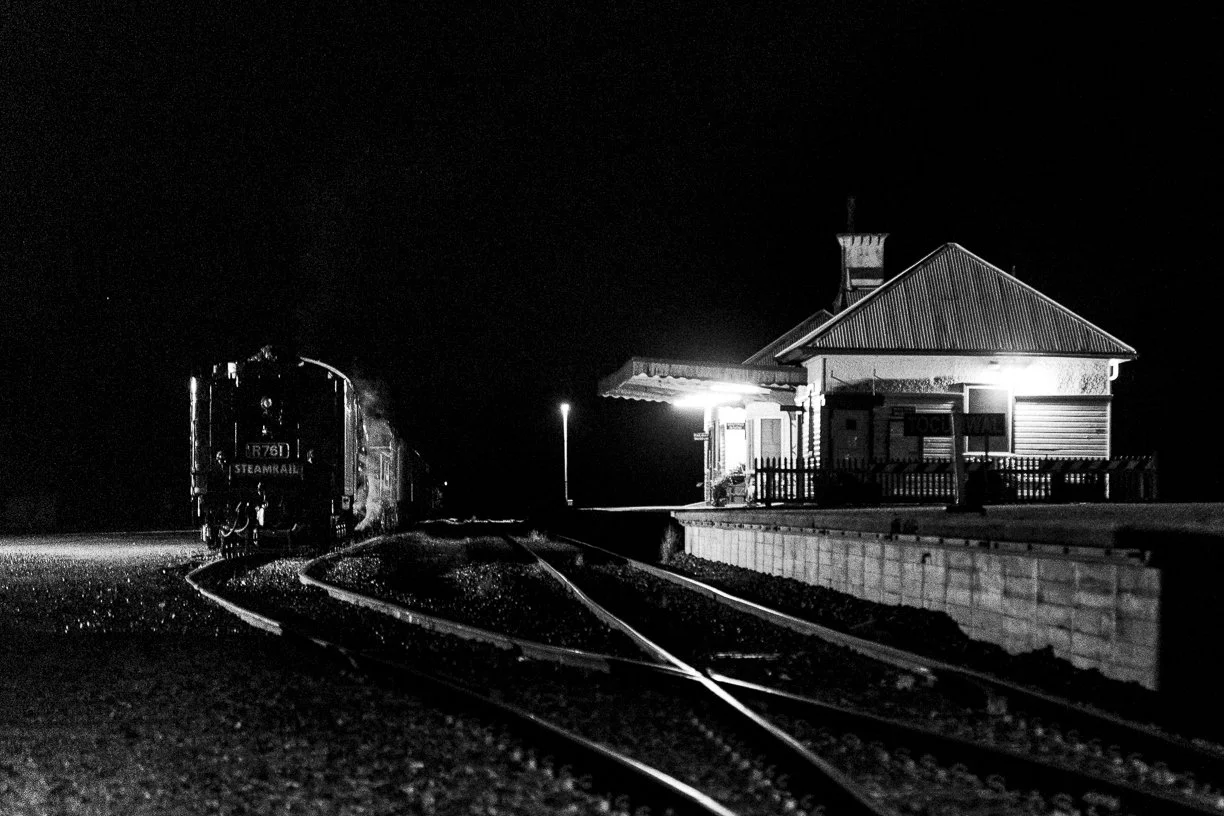
Resting with about six hours before we depart, our train is simmering quietly in the clear night air.
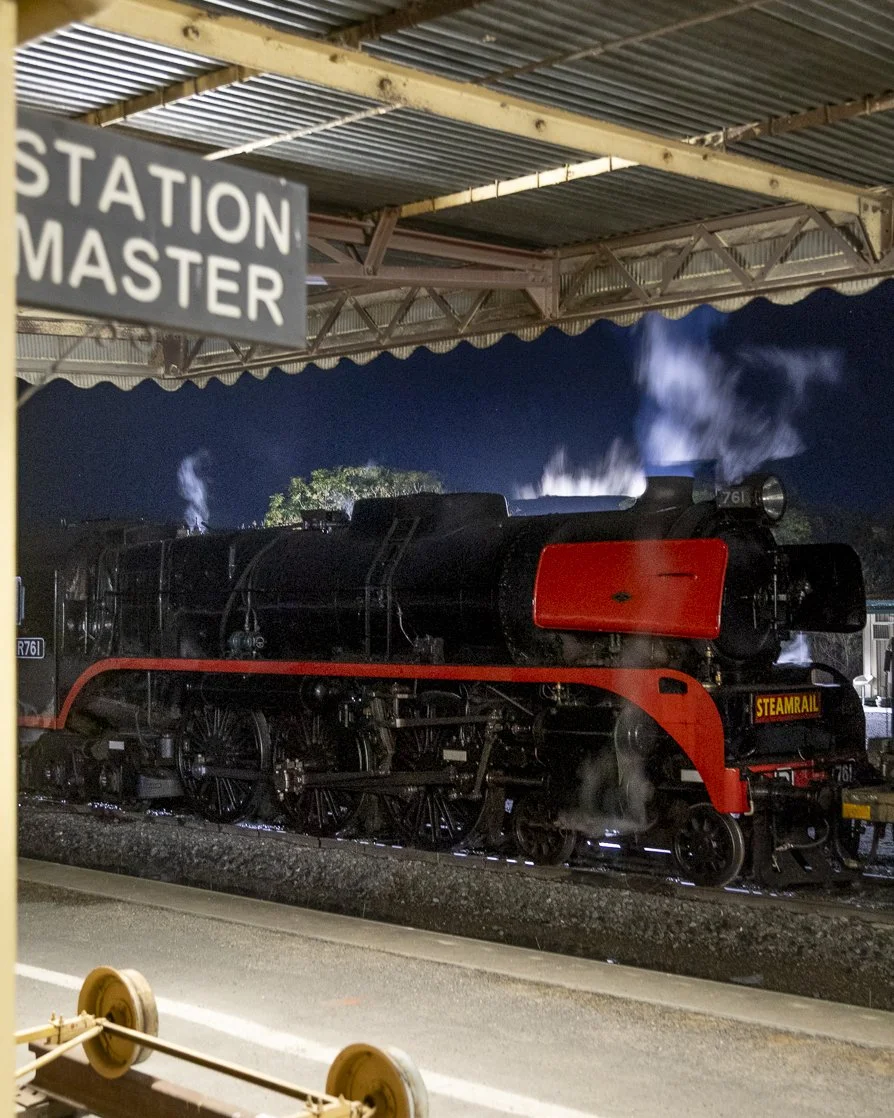
The station building at Tocumwal is beautifully presented thanks to the hard work of the Railway Heritage Museum, it was a nice frame for R 761.
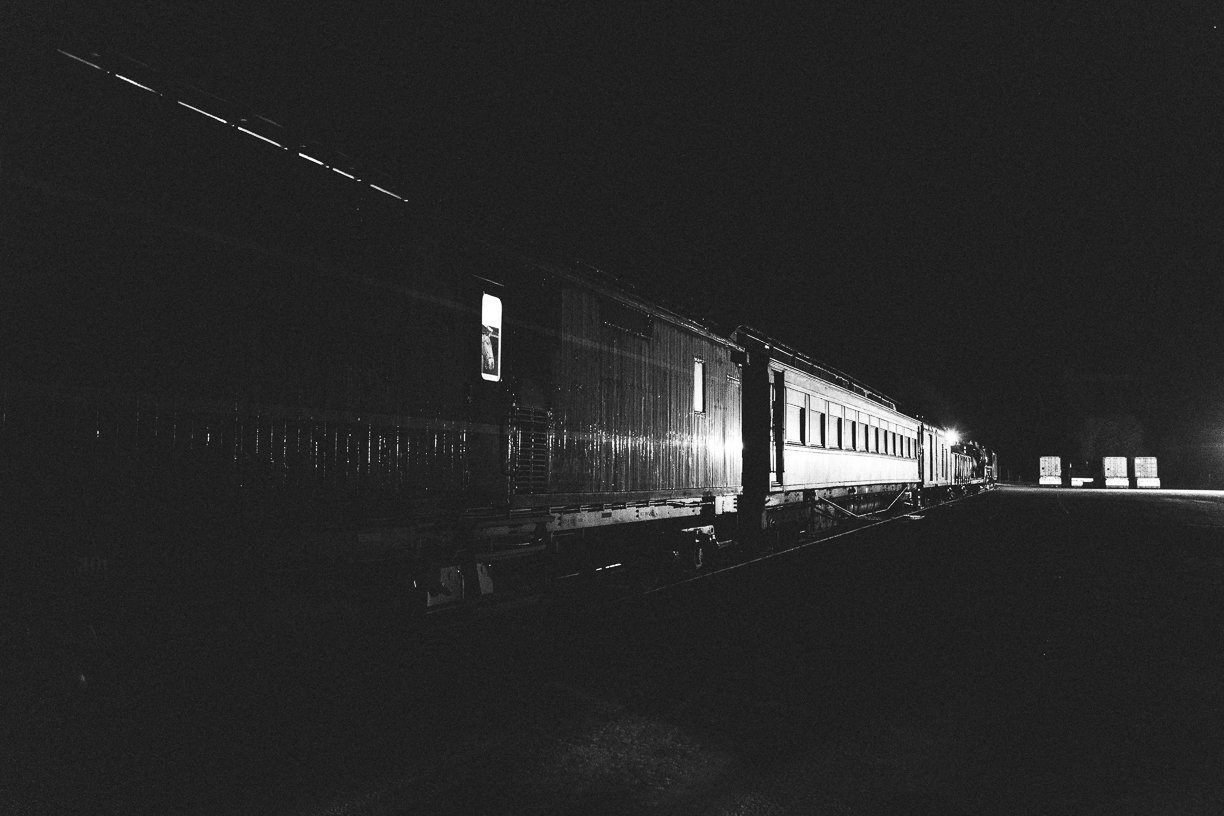
With a vigilant steed watching from Carey, it was time to end our photo session and call it a night.
The train was due out at 04:20, and there was a container train due in around 03:00, so there wasn’t high hopes of getting a great nights sleep, but, that was the adventure we’d signed up for.
What we hadn’t counted on, or checked earlier when we dropped off our bags was the bedding situation.
The bottom bed was made up, and we both assumed it would be a case of folding down the top bunk, and job done.
Not so unfortunately!
I could have gone and disturbed the carriage attendant, that’s what they’re there for, but it was late, and they would be up early to get ready to head back to town. Besides, knowing it was a full train, the chances of a random mattress being found was slim, so didn’t bother.
The bed base was reasonably soft, there was a blanket and pillow, so I snuggled in, and apparently was asleep pretty quickly.
The container train certainly made a lot of noise as it came in and clattered to a stop, waking us (and I assume the rest of the passengers), and not long after there was footsteps outside the car and down the hall as preparations were made to depart.
Sleep was fairly patchy, and I’d grabbed my coat for a bit of extra warmth at some point, but was still surprised when we pulled up at Seymour, around 08:00.
Part of the train consist was Carey, a shower car that has been serving that purpose since it was converted from a horse box - yes, a carriage originally constructed for carrying horses in 1901 with capacity for three neddies and an attendant.
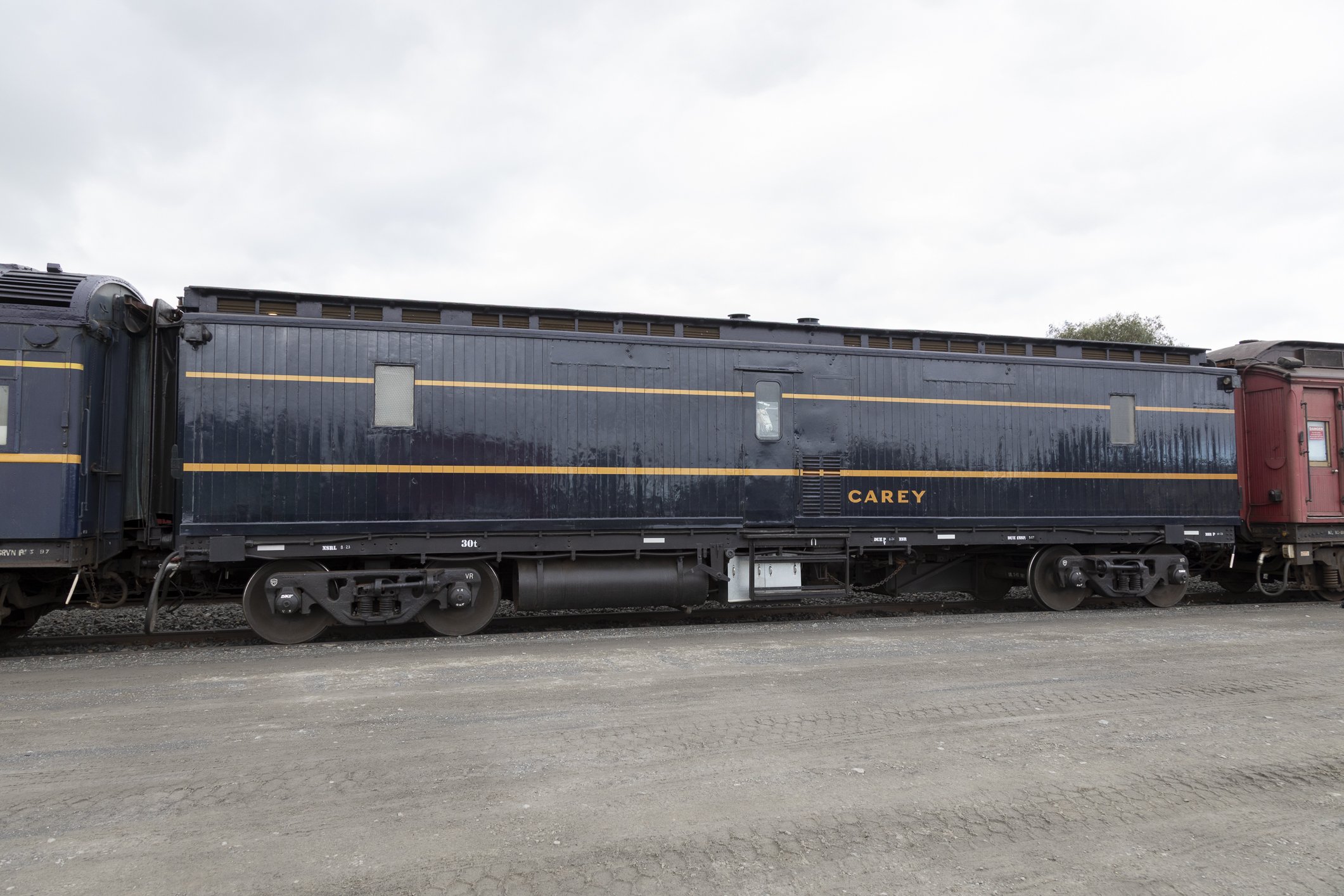
A unique, but very welcome addition on the train was shower car Carey, the hot shower was very much appreciated in the morning.
It was rebuilt in 1963 with eight showers, and was used on the Train Of Knowledge ( think of it like a travelling school camp on rails) until that was discontinued in the late 80s.
Carey, along with most of the Train of Knowledge cars ended up allocated to the Seymour Rail Heritage Centre, https://srhc.org.au/ before being transferred to Steamrail in 2014, and saw its first tour use in 2023 to Bairnsdale.
The hot shower was certainly very welcome, made more pleasant by being stationary!
Back to the compartment to finish getting ready to venture off the train in search of coffee, I was able to get a photo of our engine heading to the loco depot to turn ready for the run home.
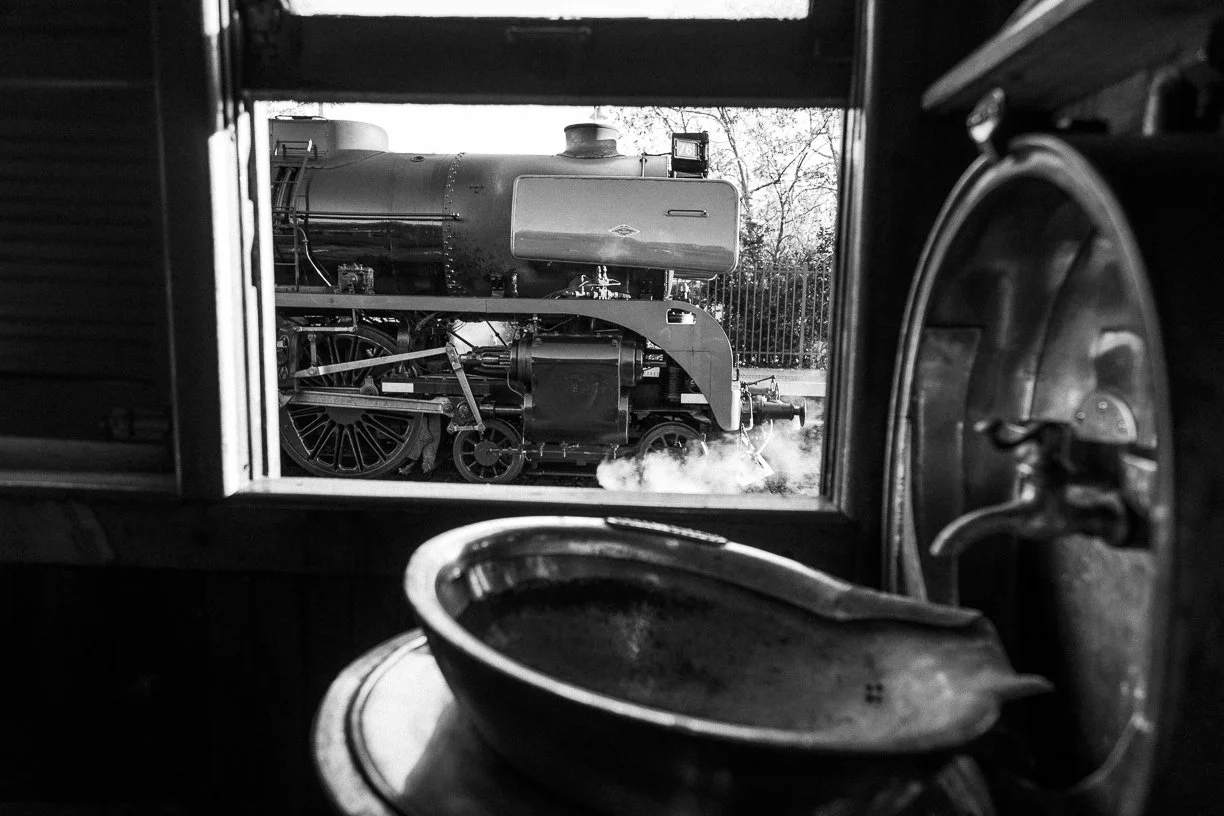
A feature of the sleeping cars is a washbasin in the corner near the window, and a great view!
A large coffee and toasted sandwich was taken in the sunlight beside the station, before wandering up to see the loco now facing south at the end of the platform. A chat with Driver Keith, and taking his photo for him in front of the R while they were waiting to get permission to rejoin the front of the train.
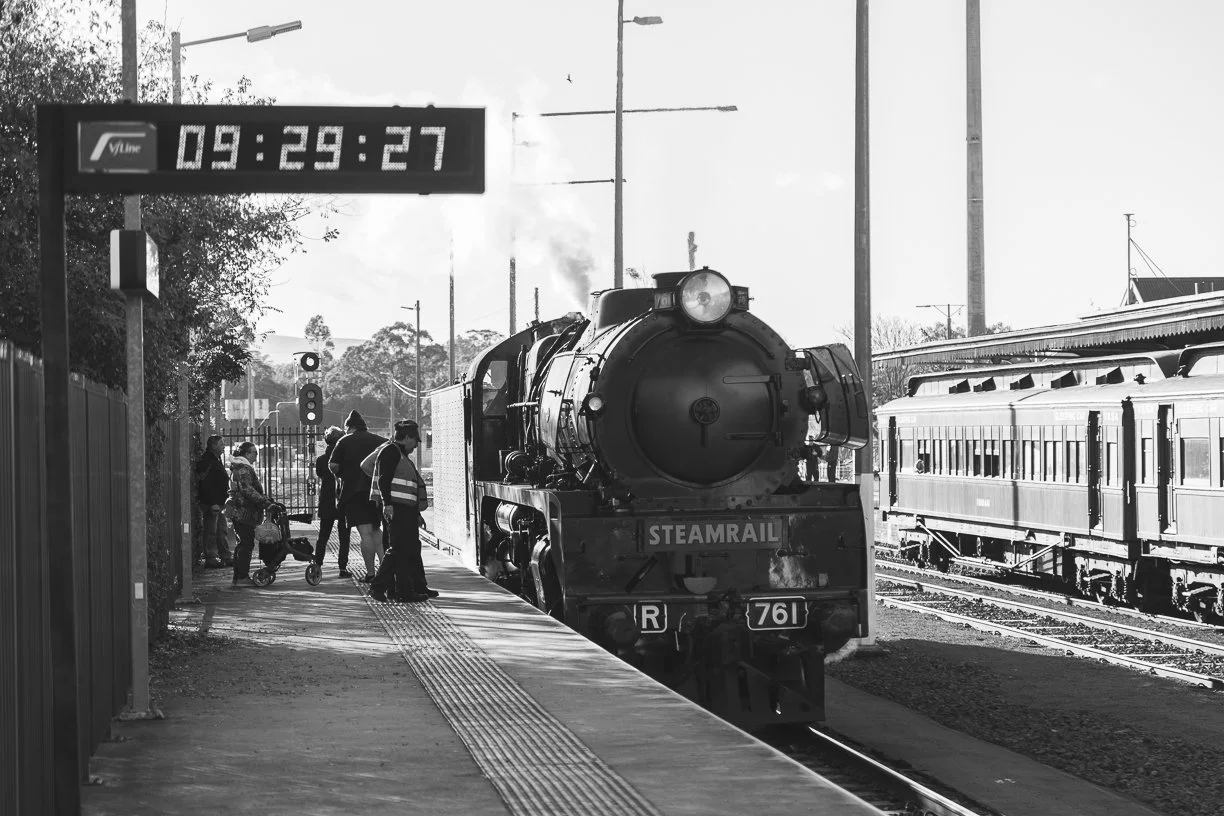
Facing towards home, one last look around the loco while waiting for a local Sprinter service to depart, and putting the loco back on the front of the train.
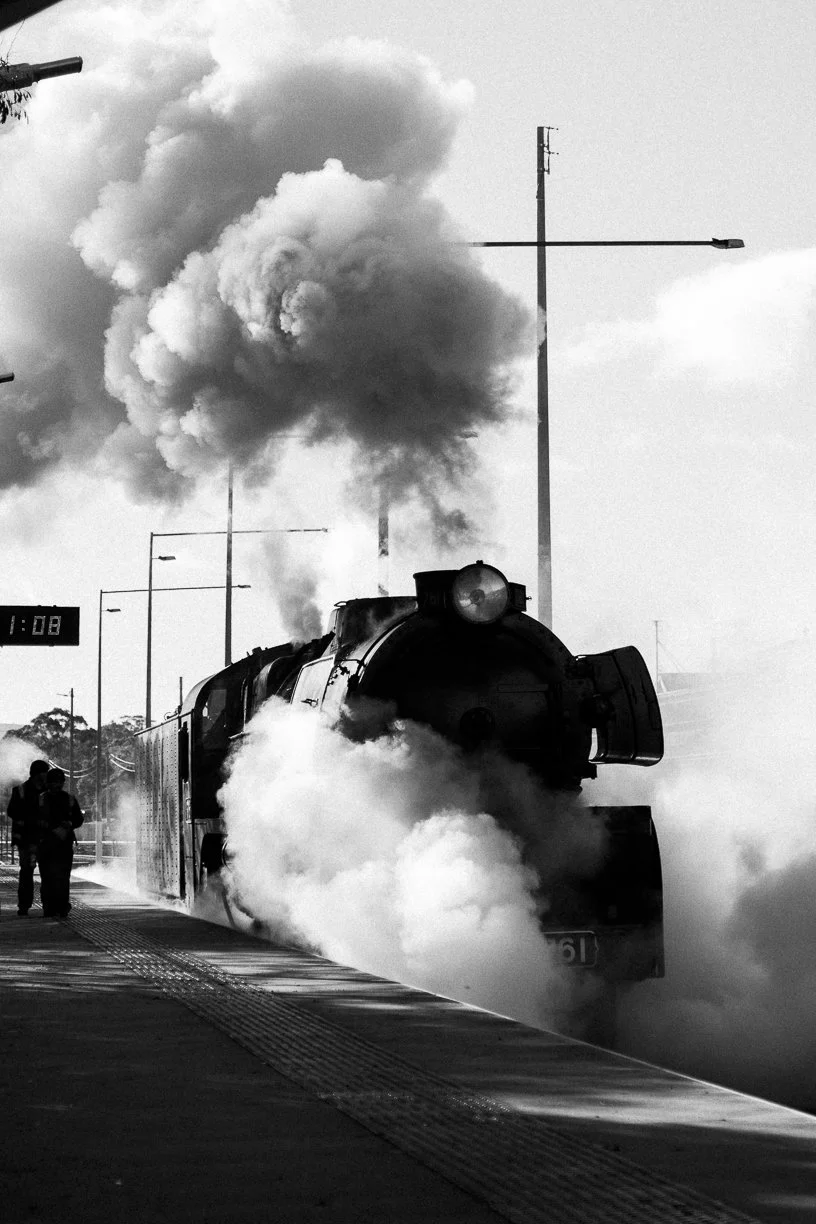
Time to go. Drain cocks open clearing water and condensation from the cylinders adds to the atmosphere as the loco pulls forward with three distinct exhaust beats hanging in the air.
A couple more photos, then we headed back to the train - there was a large crowd gathered around the loco, so we went back to our compartment to settle in for the run home.
It was comfortable in day mode, with plenty of room for the two of us, and with the corridor door closed not too cold with the window open to enjoy the sounds of the loco working over the couple of decent climbs at Tallarook, Broadford, and the summit at Heathcote Junction.
The trip felt very relaxed, not as many people as the day train, and just calmer, maybe due to only being two of us, not the usual six we end up with most train trips.
As with Friday’s train, the original scheduled route direct to Newport via Sunshine was off the table, so we went via the suburban line through Essendon and Kensington, and into the Arrivals Yard at the back of North Melbourne.
Here, the R ran around the train, and when there was a break in traffic on the RRL lines, we obtained a signal to depart over Spion Kop, and crossed over to the suburban lines at South Kensington.
Footscray, Yarraville, and soon enough our set down stop at Newport was reached, and the adventure was over.
Time for a quick thank you and goodbye to the wonderful Steamrail volunteers before the train headed back to the depot, and we met Janelle, and headed to The Junction for a delicious Sunday roast!
I’d highly recommend a sleeping car trip if you get the opportunity, either with Steamrail or 707 Operations who are running a lot of Slow Rail journeys over extended weekends, or, as a form of travel and accomodation on regular services in Europe and Continental North America, like our journey to Halifax on Viarail’s The Ocean.
Let me know if you’ve ever travelled by sleeping train, or have it on your wish list.
Thanks for reading,
Scott